
What is a Fashion Design Degree, really?
A fashion design degree isn’t just about sketching pretty outfits or following trends you see on Instagram. It’s a structured path where creativity meets discipline, and ideas turn into real, wearable designs. At its core, this degree teaches you how fashion actually works from fabric to final garment, from concept to consumer.
At ISFT College, the approach goes beyond theory. You learn how fashion behaves in the real world – how trends shift, how garments are produced, and how brands connect with people.

Why a Fashion Design Degree Still Matters Today
The fashion industry has changed. Fast.
It’s no longer just about designers sitting in studios. Today, fashion blends with technology, media, and business. A proper fashion design degree prepares you for this shift.
Here’s what makes it relevant:
- You don’t just learn design – you understand the industry
- You gain hands-on experience, not just classroom knowledge
- By building a portfolio, you are more likely to be hired
- You explore roles beyond designing (marketing, styling, media)
In short, it gives direction to your creativity.
Inside the ISFT Fashion Design Programme
The B.Sc in Fashion Design Technology at ISFT is designed to give you both creative freedom and technical clarity. It’s not rushed, and it’s not surface-level.
Programme Overview
- Eligibility: 12th pass (any stream)
- Duration: 3 Years
- Focus: Design + Technology + Industry Exposure
This balance is what makes the programme practical. You’re not just learning – you’re building skills that work outside college.
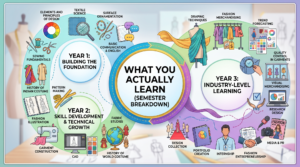
What You Actually Learn (Semester Breakdown)
What is your journey like? Let’s talk about it.
Year 1: Building the Foundation
You start from the basics, but not in a boring way.
- Elements and Principles of Design
- Textile Science
- Surface Ornamentation
- Sewing Fundamentals
- History of Indian Costume
- Basic Communication & English
This phase shapes your design thinking. You begin to understand fabrics, textures, and visual balance.
Year 2: Skill Development & Technical Growth
Now things get more hands-on.
- Fashion Illustration
- Pattern Making
- Garment Construction
- CAD (Computer-Aided Design)
- Fabric Studies
- History of World Costume
You start creating actual garments, not just ideas. Digital tools are introduced, which is essential in today’s fashion space.
Year 3: Industry-Level Learning
This is where it gets real.
- Draping Techniques
- Fashion Merchandising
- Trend Forecasting
- Quality Control in Garments
- Visual Merchandising
- Research Design
And finally:
- Design Collection
- Portfolio Creation
- Internship
- Fashion Entrepreneurship
- Media & PR
By the end, you’re not just a student anymore – you’re ready to step into the industry.
Real Exposure: Not Just Classroom Learning
One thing that stands out is how ISFT focuses on experience.
Students are encouraged to:
- Participate in fashion presentations
- Work on live projects
- Attend workshops and seminars
- Complete internships
- Build a strong personal portfolio
This matters because fashion is not a “theory-heavy” field. You learn by doing.
Skills You Develop During the Course
Your creativity is not the only thing shaped by a fashion design degree. It builds a mix of practical and professional skills.
Creative Skills
- Sketching and illustration
- Fabric understanding
- Styling and aesthetics
Technical Skills
- Pattern making
- Garment construction
- Digital design tools (CAD)
Industry Skills
- Trend analysis
- Merchandising
- Branding and communication
Personal Skills
- Confidence in presentation
- Problem-solving
- Attention to detail
These are the skills that actually help you get hired or start something of your own.
Career Opportunities After a Fashion Design Degree
The most common question students have is “What can I actually do after this? ”
The answer: a lot more than you think.
Design Roles
- Fashion Designer
- Textile Designer
- Fashion Illustrator
Styling & Media
- Stylist
- Fashion Blogger
- Fashion Journalist
Business & Industry Roles
- Fashion Merchandiser
- Fashion Coordinator
- Garment Technologist
- Fashion Technologist
Trend & Strategy
- Trend Forecaster
- Fashion Consultant
And if you’re someone who wants independence:
- Start your own label
- Build a personal brand
- Work as a freelance stylist or designer
This degree doesn’t lock you into one path – it opens multiple doors.
How This Degree Prepares You for the Real World
Many courses teach skills. But very few teach how to use them.
At ISFT, the focus is on:
- Practical training every semester
- Industry-relevant curriculum
- Internship exposure
- Portfolio development
By the end of the programme, you’re not just holding a degree – you have proof of your work.
If you want to explore the complete course structure and details, you can check it here:
https://www.isftcollege.com/b-sc-fashion-design-technology/
Is This Course Right for You?
Let’s be honest – fashion isn’t for everyone.
This degree is for you if:
- You notice details in clothing others ignore
- You enjoy creating, not just consuming fashion
- You’re willing to learn technical skills (not just design)
- You want a career that blends creativity with business
If you’re just looking for something “easy” – this isn’t it.
But if you’re serious about building something in fashion, this can be the right start.
What Makes ISFT Different?
Every college offers a course. But the difference lies in how it’s taught.
At ISFT:
- Learning is practical, not just theoretical
- Students work on real projects
- Industry exposure is built into the curriculum
- Portfolio creation is taken seriously
This approach helps students move smoothly from college to career.
The Real Impact of a Fashion Design Degree
A good fashion design degree changes how you see everything – clothes, people, trends, even business.
You stop asking, “What looks good?”
And start asking, “Why does this work?”
That shift is what turns a student into a professional.
Final Thoughts
Choosing a career in fashion is a big decision. It’s creative, but also competitive. It requires patience, consistency, and a willingness to learn continuously.
A structured programme like the one at ISFT gives you:
- Direction
- Skill
- Exposure
- Confidence
And most importantly – a starting point that actually leads somewhere.
If you want to understand the full scope of what this programme offers, you can explore more here:
https://www.isftcollege.com/b-sc-fashion-design-technology/